
Disclaimer: Views in this blog do not promote, and are not directly connected to any L&G product or service. Views are from a range of L&G investment professionals, may be specific to an author’s particular investment region or desk, and do not necessarily reflect the views of L&G. For investment professionals only.
Minimum issue screens in global aggregate bond indices: a cost/benefit analysis
Our analysis indicates potential investability benefits, based on fewer holdings and lower estimated implementation costs with minimal diversification, currency exposure and risk trade-offs.

One of the enjoyable aspects of an investment specialist’s role is the opportunity to take a hypothesis and test it in detail to determine whether it holds.
In this article, I’ll examine how adding a minimum issue threshold to a common set of global aggregate bond indices could change the investment characteristics of the indices from an index investing perspective.
Let’s start by considering why adding this requirement might be desirable:
- Potential to improve benchmark investability and replicability by focusing on larger, more liquid issues with minimal impact on overall credit quality and risk exposure.
- Increasing issue size could improve sampling efficiency and operational scalability while reducing exposure to smaller, less liquid bonds.
- The threshold could result in more efficient index tracking, lower turnover and greater scalability as assets grow.
So, does this hypothesis stand up to empirical analysis, and what impacts does the additional requirement have on other aspects of the indices’ investment characteristics?
Reduction in number of securities
For the purposes of this analysis, we have examined three widely followed indices: the Bloomberg Global Aggregate Index, the Bloomberg Global Aggregate 1-5 Year Index and the Bloomberg Global Aggregate 1-3 Year Index.[1] The addition of a minimum issue threshold of $500 million (known as the 500MM indices) removes a number of securities from each of the indices:
- 8,370 securities (-26%) and 806 issuers (-25%) vs Bloomberg Global Aggregate Index.
- 4,589 securities (-29%) and 580 issuers (-23%) vs Bloomberg Global Aggregate 1-5 Year Index.
- 2,641 securities (-31%) and 482 issuers (-24%) vs Bloomberg Global Aggregate 1-3 Year Index.
The impact of screening increases as duration shortens. Most removed bonds are small issues, and the number of issuers falls ~23-25%. Importantly, though, the vast majority of underlying markets is still preserved.
How the screening changes the indices

Source: L&G, Bloomberg, 31/7/2026.
In terms of which specific securities are removed, we observe that ~50% of securitised securities are removed in the screened version of the Bloomberg Global Aggregate Index, but this represents only ~1.24% of the full index weight, with many small positions lost.
Corporate and government-related sectors are removed similarly, while Treasuries are least affected. There is no material bias against lower-rated issuers.
Issuer/sector concentration and risk characteristics
The obvious follow-up to the observation that the screen predictably reduces the number of securities across the three indices is what this means for concentration and overall risk?
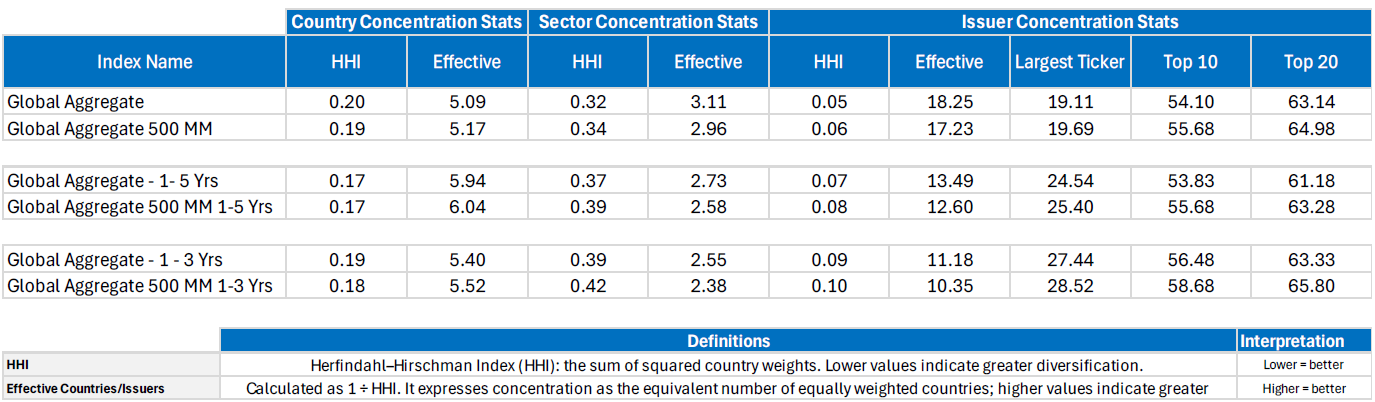
The Herfindahl-Hirschman Index (HHI) provides an academically established measure of market concentration by squaring the market share of each firm in the market and summing the results. By this measure, we can see that issuer concentration does increase, but only very marginally. Issuer HHI rises from ~0.055 to 0.058 (full), 0.074 to 0.079 (1-5yr) and 0.089 to 0.097 (1-3yr).
Country concentration declines marginally in the modified indices, while we see minimal changes across a range of other measures:
- The number of effective sectors is stable (3.11 → 2.96 for full universes).
- Issuer concentration rises modestly: largest ticker ~19.11% → 19.69%; Top 10 issuers ~54.10% → 55.68%.
- Number of effective issuers falls ~6-7% (18.25 → 17.23 for full universes; 13.49 → 12.60 for 1-5yr; 11.18 → 10.35 for 1-3yr).
Concentration metrics
Source: L&G, Bloomberg, 31/7/2026.
The impact on overall risk metrics is negligible. Yield to maturity falls 2-4 basis points (bps); the option-adjusted spread tightens 1-2bps; duration is unchanged; average bonds per issuer ~10 is unchanged. It’s important to note that the majority of bonds removed are small-ticket bonds.
Credit quality is also largely unchanged following the application of the 500MM screen. The screened indices exhibit modestly lower exposure to BBB-rated bonds and slightly higher weights in higher-quality rating buckets, resulting in a marginal improvement in overall average credit quality. Given this modest improvement, the small reduction in yield is unlikely to be explained by credit risk alone and is more consistent with the removal of smaller, less liquid issues that may offer a liquidity premium.
In effect, investors are exchanging a limited amount of yield for a potentially more investable and scalable benchmark universe.
Our analysis also found currency exposures remain highly stable following the additional screening. The currency concentration (HHI) of the 500MM version of the Bloomberg Global Aggregate Index was unchanged versus the base index, and the effective currency concentration increased only fractionally from 3.57 to 3.60. Our research found no indication that the screening materially alters the currency opportunity set.
Implementation cost and liquidity benefits versus market impact
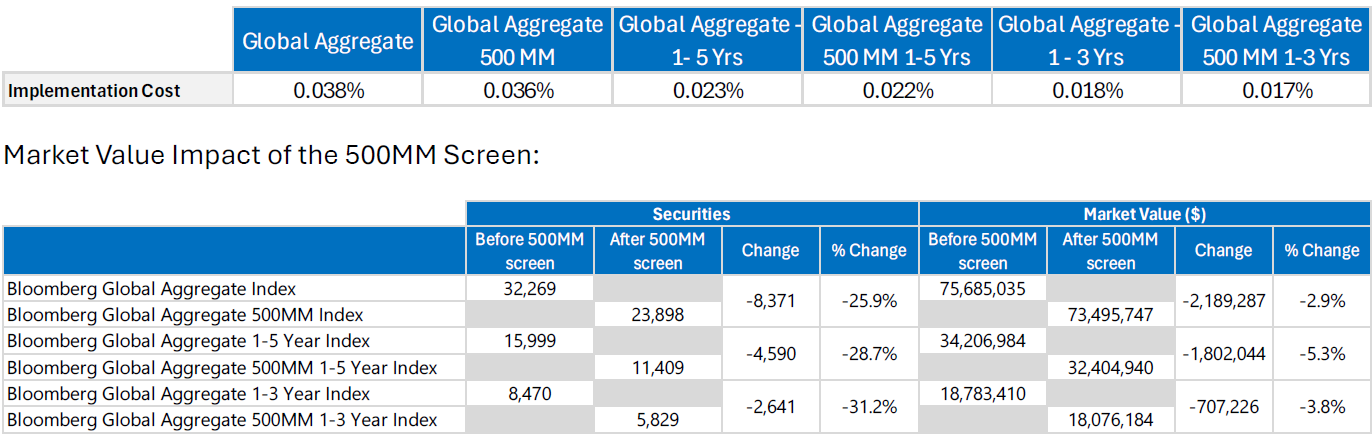
With fewer securities, larger issue size, improved sampling and reduced exposure to very small securitised issues, implementation costs for the screened indices fall, though it’s important to note this analysis does not directly measure realised liquidity, turnover, tracking error or execution outcomes.
While the 500MM methodology removes between 26% and 31% of securities across the various universes, the impact on total benchmark market value is observed to be significantly smaller. This demonstrates that the securities removed by the screen are disproportionately concentrated in smaller issues and contribute limited overall market-value exposure.
As a result, the methodology potentially improves investability while maintaining exposure to the vast majority of the underlying bond market. Under the stated modelling assumptions, estimated implementation costs were lower for the screened indices. Actual costs may differ according to portfolio size, trading conditions, cash flows, sampling approach and execution.
Implementation costs
Source: L&G, Bloomberg, 31/7/2026.
Conclusion: Improved investability with modest trade-offs
We believe our analysis suggests – on a theoretical basis – that the 500MM methodology does indeed offer improved investability with minimal diversification, currency exposure and risk trade-offs.
The analysis shows that the 500MM methodology removes a substantial number of securities, but only a small proportion of overall market value (2.9%-5.3% across the universes analysed). While the screened indices exhibit slightly lower yields, credit quality is marginally improved, with modest reductions in BBB exposure and increases in higher-rated securities.
This suggests that much of the yield difference reflects the exclusion of smaller, less liquid bonds rather than a meaningful change in the underlying credit opportunity set.
Past performance is not a guide to the future. Assumptions, opinions, and estimates are provided for illustrative purposes only. There is no guarantee that any forecasts made will come to pass. Figures, data and views are accurate as at 31 July 2026, unless otherwise stated, and may be subject to change. It should be noted that diversification is no guarantee against a loss in a declining market.
[1] The Bloomberg Global Aggregate 1-5 Year Index is a custom index created as a carve-out from the Bloomberg Global Aggregate Index for the purposes of this analysis.

Recommended content for you
Learn more about our business
We are one of the world's largest asset managers, with capabilities across asset classes to meet our clients' objectives and a longstanding commitment to responsible investing.