
Disclaimer: Views in this blog do not promote, and are not directly connected to any L&G product or service. Views are from a range of L&G investment professionals, may be specific to an author’s particular investment region or desk, and do not necessarily reflect the views of L&G. For investment professionals only.
Investment opportunities: Frontier market equity
Small markets, big opportunities?

For our fiduciary management and OCIO clients, we continuously assess investment opportunities across public and private markets, leveraging both our in-house capabilities and extensive research across the wider asset management industry. Through our investment opportunities blog series, we share our latest insights and perspectives. In this edition, we explore frontier market equity, examining the potential benefits of investing beyond mainstream markets and some of the implementation considerations that accompany them.
The case for frontier equities
Frontier market equity offers exposure to economies and companies at an earlier stage of capital-market development than mainstream emerging markets. These markets are typically smaller, less liquid and less accessible, but can provide access to growth themes under-represented in mainstream indices. For long-term investors able to tolerate governance complexity and implementation challenges, frontier equities can play a distinctive role within a diversified portfolio.
The attraction begins with growth. Many frontier economies benefit from favourable demographics, rising consumption, improving financial inclusion, infrastructure catch-up and rapid urbanisation as institutions and markets deepen. These characteristics can create opportunities in areas such as banking, real estate, consumer goods, logistics, technology adoption and local services, particularly where economic growth translates into corporate profitability.
Attractive valuations are another important feature in our view Frontier markets trade at lower valuation multiples than developing and emerging markets, while still offering exposure to companies with attractive profitability characteristics. The frontier universe is far smaller than mainstream emerging markets, with fewer stocks, lower aggregate market capitalisation and a more pronounced small and mid-cap profile. For active managers, that can create opportunities to add value through local research, governance assessment and security selection.
Implementation considerations
Frontier markets are also characterised by a wider dispersion of outcomes than many developed markets. Market accessibility, governance standards, liquidity and regulatory frameworks can vary significantly between countries and companies, making implementation an important consideration for investors.
When evaluating frontier market equity managers, we recognise that success is often driven as much by country allocation and implementation as by stock picking. We therefore assess how managers define their universe, allocate capital across countries, and manage liquidity in less-accessible markets. Local research capabilities, capacity discipline and a well-defined investment process can all support long-term outcomes.
Frontier markets are not a homogeneous opportunity set. Index composition can be concentrated and can shift as countries are upgraded to, or downgraded from, emerging market status. Countries such as Vietnam, Morocco and Romania are currently sizeable constituents in frontier benchmarks, but the mix changes over time. Sector exposure is also distinctive: financials are often heavily represented, while technology is typically a much smaller share than in developed or broader emerging markets. This gives frontier equities a different style and sector profile, with more exposure to value, domestic cyclicality and financial deepening.
Portfolio role and diversification
Investors in this space have been rewarded over the medium and long-term; frontier markets have outperformed emerging markets on a trailing 3, 5 and 15-year basis (shown below). Frontier markets lag on a 20-year basis, in part due to 2006’s Gulf sell-off and a weaker post-global financial crisis rebound. Meanwhile, frontier markets have generally exhibited lower realised volatility than emerging markets, in part due to lower liquidity and correlations, although volatility in frontier markets can spike higher in crisis periods, which demonstrates the higher tail risks.
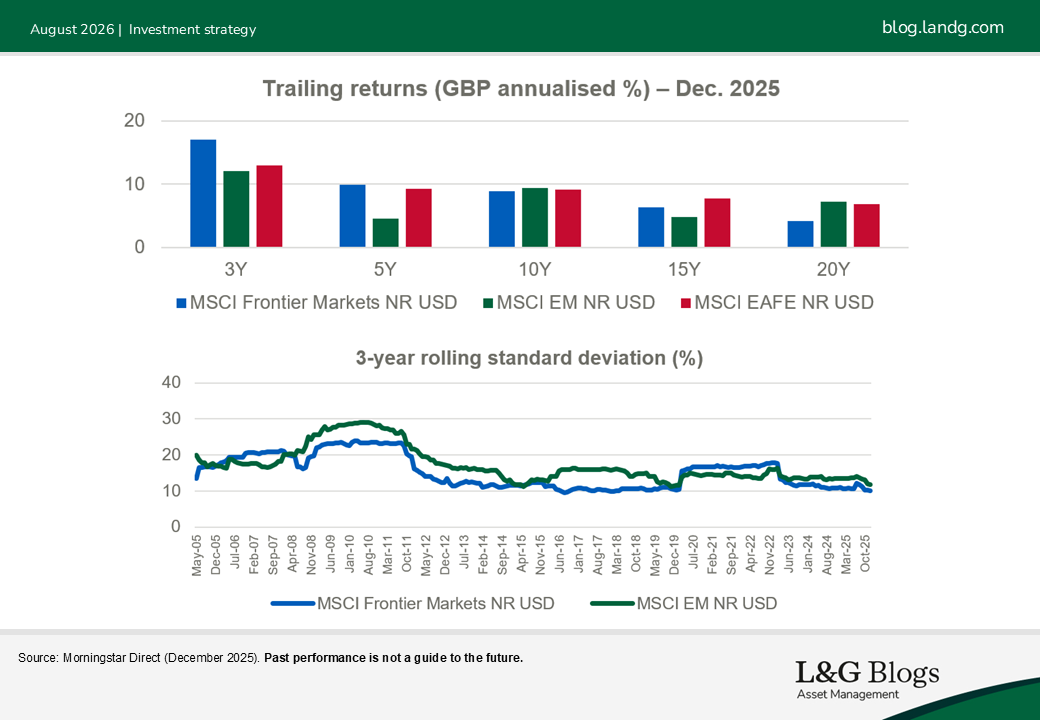
The diversification case is central in our view Frontier market equities have historically shown lower correlations with developed-market equities than broader emerging markets, although correlations can rise during periods of stress. This is intuitive: frontier markets are often driven more by domestic politics, local rates, currency regimes, reforms and country-specific growth than by the global mega-cap equity cycle. For long-horizon investors, this can help to provide a differentiated return stream, particularly when equity portfolios are dominated by the US and large global growth stocks.
Past performance is not a guide to the future. Assumptions, opinions, and estimates are provided for illustrative purposes only. There is no guarantee that any forecasts made will come to pass. It should be noted that diversification is no guarantee against a loss in a declining market.


Recommended content for you
Learn more about our business
We are one of the world's largest asset managers, with capabilities across asset classes to meet our clients' objectives and a longstanding commitment to responsible investing.