Disclaimer: Views in this blog do not promote, and are not directly connected to any L&G product or service. Views are from a range of L&G investment professionals, may be specific to an author’s particular investment region or desk, and do not necessarily reflect the views of L&G. For investment professionals only.
Investment opportunities: Collateralised loan obligations
Beyond the acronym – making sense of CLOs and their investment potential.

For our fiduciary management and OCIO clients, we continuously assess investment opportunities across public and private markets, leveraging both our in-house capabilities and extensive research across the wider asset management industry. Through our investment opportunities blog series, we share our latest insights and perspectives. In this edition, we explore the case for collateralised loan obligations and the potential opportunities they can offer long-term investors.
What is a collateralised loan obligation?
A collateralised loan obligation (CLO) is an actively managed investment vehicle that holds a diversified portfolio of leveraged loans. These are loans made to companies with relatively high levels of debt compared with their earnings, often resulting in a below-investment-grade credit rating and a higher risk of default. The term “leveraged” refers to the financial leverage of the borrowing company, meaning its use of debt to finance its business or an acquisition, rather than to borrowing undertaken by the CLO itself.
The loans are typically senior-secured: “senior” means they rank ahead of more junior debts for repayment if the borrower becomes insolvent, while “secured” means they are backed by claims over the borrower’s assets. They are generally also first-lien, meaning the lenders have the highest-priority claim over those assets. The floating-rate nature of the loans can potentially make them attractive in a rising rate environment as the interest paid rises with short-term market interest rates. However, this means the income can also fall.
The CLO vehicle finances the purchase of the loan portfolio by issuing different layers of securities, known as tranches, ranging from senior debt with the highest credit rating of AAA, to an equity tranche, which is paid last and does not have a credit rating. Cash received from the underlying loans is distributed through a predetermined waterfall, with the most senior tranches paid first. Junior debt and equity investors are paid later and absorb losses before the senior tranches. This ranking of claims, known as subordination, creates a financial buffer that helps protect the more senior tranches and supports their higher credit ratings. Typically, AAA makes up around 65% of CLO assets, 22% AA – BBB with the balance BB and equity[1].
In addition, in Europe, a CLO originator, sponsor or original lender is typically required to retain at least 5% of the economic interest in the transaction due to “risk retention” requirements under the EU Securitisation Regulation. Although not a credit enhancement in itself, this does help to align interests between transaction sponsors and investors.
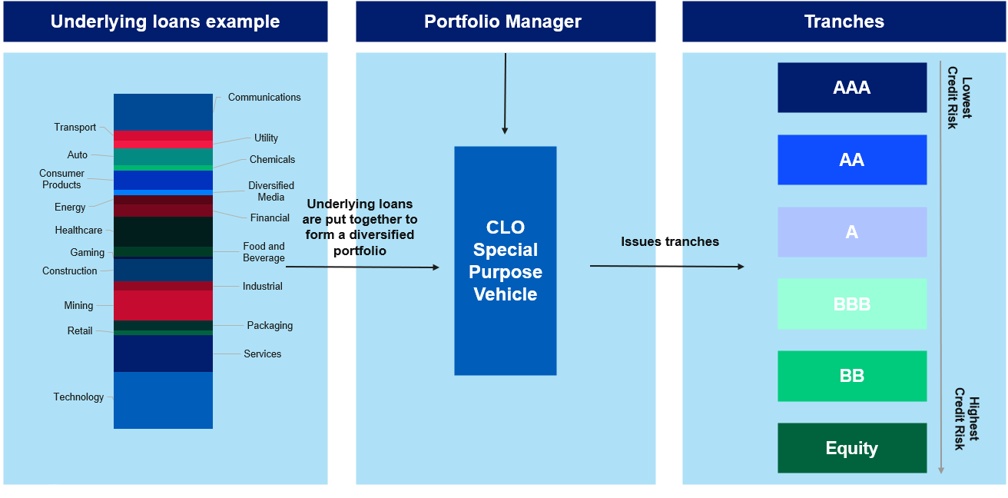 Source: L&G.
The investment case for different CLO tranches
The global CLO market has grown substantially over the past decade to $1.5 trillion as of 2026 and is a key source of funding for issuers of leveraged loans (around 70% of loan demand comes from CLOs[2]). Continued issuance and strong investor demand have helped establish CLOs as a mainstream segment of global credit markets.
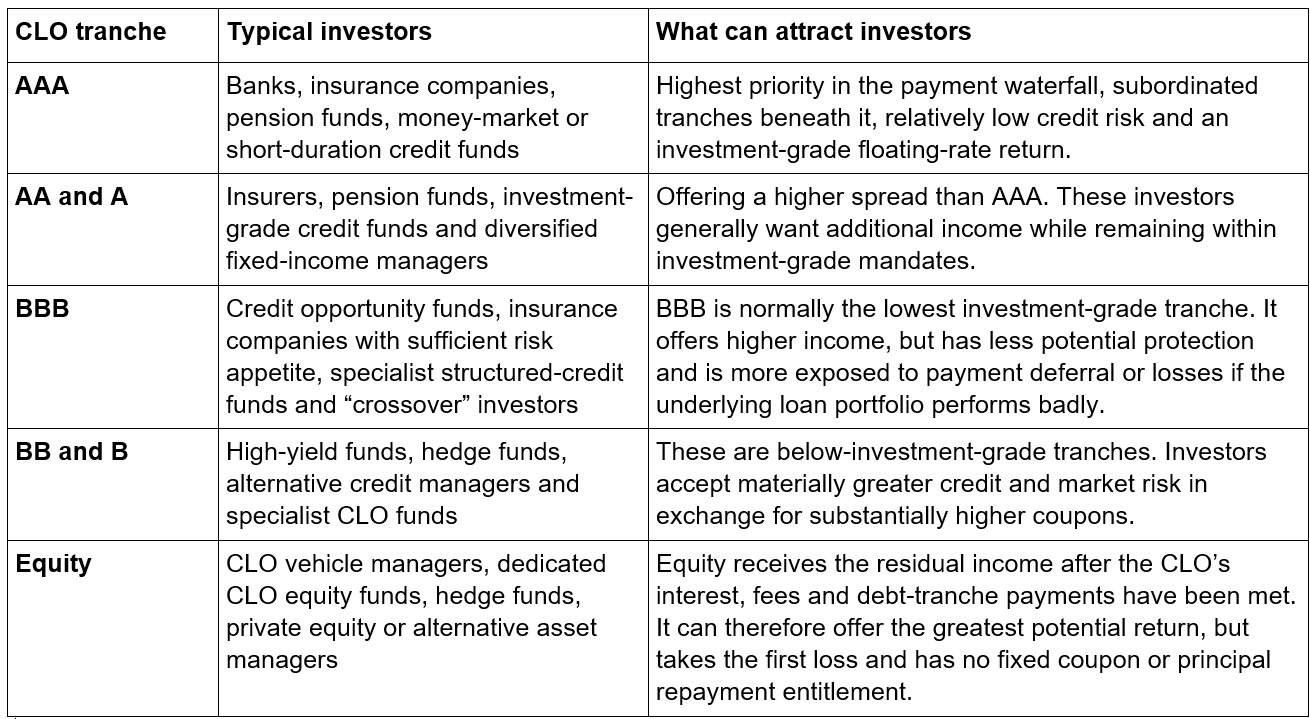
Different CLO tranches appeal to different investors, because each offers a different combination of credit rating, yield, capital treatment, liquidity and risk of loss. CLO debt tranches have historically offered a spread premium relative to similarly rated corporate bonds, reflecting factors such as structural complexity, a more specialised investor base and lower liquidity than traditional credit markets.
For many investors, CLOs can also provide potential diversification benefits. The underlying collateral is typically diversified across numerous issuers and sectors, helping to reduce exposure to any single credit event. In addition, historically CLO debt tranches have experienced lower realised default rates than similarly rated corporate bonds[3].
What are the risks?
CLOs remain exposed to corporate credit risk, and a rise in loan defaults and downgrades or seeing recoveries below expectations could reduce returns or cause losses. Market liquidity can also deteriorate during periods of stress, with lower-rated tranches generally more vulnerable to price volatility due to spread widening than senior tranches. The floating-rate nature of the securities must also be considered, as it means that income can fall in line with broader market interest rates. CLOs also exhibit higher weightings to the software sector at around 13%[4] so this is worth being aware of in the context of overall portfolio allocations.
Investors should also consider structural complexity risks. The tranche structure of CLOs may remind some readers of the mortgage-backed securities associated with the global financial crisis; the key difference is that the underlying assets are predominantly senior secured loans to companies, rather than residential mortgages. In addition, securitised market structures and practices have evolved significantly since the financial crisis, with greater transparency, more robust risk management and strengthened regulatory oversight.
Implementation options
The individual CLO tranche securities issued can be held directly on a segregated basis as part of a diversified active fixed income portfolio, or when paired with interest rate and/or inflation swaps may form part of a cashflow-driven investment portfolio for insurers or DB pension schemes. In these cases, security selection will be important. Unlike other securitisations, each CLO vehicle is actively managed by a specialist collateral manager, so the capabilities of the CLO vehicle manager need to be assessed when selecting securities: underwriting discipline, trading skill, and portfolio construction capabilities.
For investors accessing CLO tranche securities through a fund, both passive and active security selection options are available. CLO securities are typically excluded from the major broad market indices (e.g. Bloomberg US Aggregate Index) but may be found in specialist indices such as the J.P. Morgan Collateralized Loan Obligation Index (CLOIE). Active management may provide access to a broader universe, as well as the opportunity to access manager skill.
When evaluating CLO funds, we consider how the fund manager selects underlying CLO vehicle managers and tranches, manages concentration and liquidity, and sources assets in primary and secondary markets. We also assess diversification across CLO vehicle managers, vintages and individual positions, alongside the fund’s resilience during stressed markets. Scale can support diversification, market access and execution, and fees are always important when carry is the key driver of returns.
It should be noted that diversification is no guarantee against a loss in a declining market.
[1] Source: Guggenheim July 2025
[2] Source: JPM August 2026
[3] Source: Moody’s, “Impairment and loss rates of structured finance securities: 2009-2023” and “Annual default study 2023”.
[4] Source: JPM August 2026


Recommended content for you
Learn more about our business
We are one of the world's largest asset managers, with capabilities across asset classes to meet our clients' objectives and a longstanding commitment to responsible investing.