
Disclaimer: Views in this blog do not promote, and are not directly connected to any L&G product or service. Views are from a range of L&G investment professionals, may be specific to an author’s particular investment region or desk, and do not necessarily reflect the views of L&G. For investment professionals only.
High rates and endgame optionality
Stronger funding positions are giving UK and US defined benefit plans greater freedom to choose their destination – and more reason to build portfolios that keep multiple paths open.

Higher government bond yields have improved funding levels globally and expanded the choices available to defined benefit (DB) plans. In the UK, gilt yields have continued to rise, while in the US, higher Treasury yields and market movements have also helped many plans move into surplus. Across both markets, this improved position is widening endgame options and bringing the management of liabilities and surplus into sharper focus.
Keeping multiple paths open
Some plans are moving towards buyout or pension risk transfer; others are running on for now, preserving flexibility while weighing their options. Longer-term run-on is being considered by many UK plans, particularly larger ones, where scale can support the investment capabilities and governance needed. In the US, hibernation similarly involves retaining the plan and managing liabilities as they run off, while considering how surplus assets might support growth, benefit enhancements or other strategic objectives.
These choices need not require an immediate commitment to a single destination. For plans balancing continued operation with a potential future transfer, today’s rate environment may offer an opportunity to strengthen liability management against a more conservative valuation basis and move closer to the cost of eventual risk transfer.
Building a portfolio around benefit payments
Across these paths, cashflow-driven investing (CDI) is becoming more important. Meeting benefit payments from investment income and maturing assets can reduce reliance on asset sales and provide greater certainty over future cashflows.
Yet higher government bond yields do not necessarily make corporate bonds attractive: tight spreads leave less compensation for taking credit risk, complicating decisions about where to invest. Many plans are therefore supplementing traditional sovereign and corporate bond portfolios with a wider range of cashflow-generating assets, such as securitised credit and private credit, as well as other alternatives. These can broaden the opportunity set, but their cashflows need careful assessment alongside credit quality, liquidity and structural complexity.
Building an effective CDI strategy is not only about deploying new capital; it also means deciding what role existing illiquid holdings should play in endgame portfolios. Plans can fold expected distributions into their cashflow management plans, or decide whether, when and how to sell, weighing secondary market pricing against ongoing cashflow requirements and evolving endgame objectives.
Managing liabilities and surplus together
For plans considering longer-term run-on in the UK or hibernation in the US, the broad balance-sheet framework used by life insurers potentially offers a useful point of reference. It distinguishes between a portfolio focused on liability coverage and benefit payments, and a surplus portfolio invested according to the sponsor’s objectives and risk tolerance.
The liability-focused portfolio can combine a broad range of assets designed to match cashflows, help deliver an attractive yield, and seek to protect against interest-rate and inflation risk. The surplus portfolio can then provide a buffer focused on preserving capital and maintaining resilience, while seeking to generate growth over time.
Crucially, these are complementary parts of one coherent, liability-aware portfolio, drawing on the full spectrum of investment opportunities available. Investments need to work together to meet benefit payments, protect hard-won surpluses, withstand market setbacks and maintain agility. For UK and US plans alike, the appropriate balance will depend on whether a plan is preparing for buyout or pension risk transfer, keeping its options open, or investing for long-term run-on in the UK or hibernation in the US.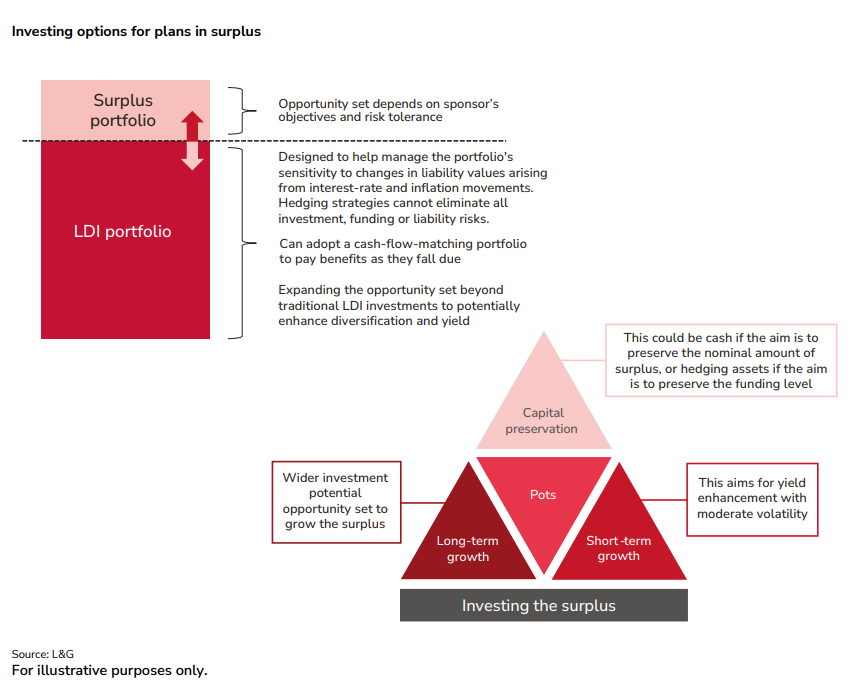


Recommended content for you
Learn more about our business
We are one of the world's largest asset managers, with capabilities across asset classes to meet our clients' objectives and a longstanding commitment to responsible investing.