
Disclaimer: Views in this blog do not promote, and are not directly connected to any L&G product or service. Views are from a range of L&G investment professionals, may be specific to an author’s particular investment region or desk, and do not necessarily reflect the views of L&G. For investment professionals only.
Defensive growth when the ground is shifting?
Considering the role of defensive synthetic equity for DB schemes.

The revised DB funding code reinforces the need for clear long-term objectives, a progressively lower reliance on the sponsor at maturity, and demonstrable risk management, particularly through stress testing and liquidity planning. For more detail see our blog: Rising to the challenge.
Trustees may therefore want to consider whether their current equity exposure aligns with their broader journey plan and governance framework. The decision will depend on many factors, including covenant strength, liquidity needs, long-term objectives, and the role that growth assets continue to play.
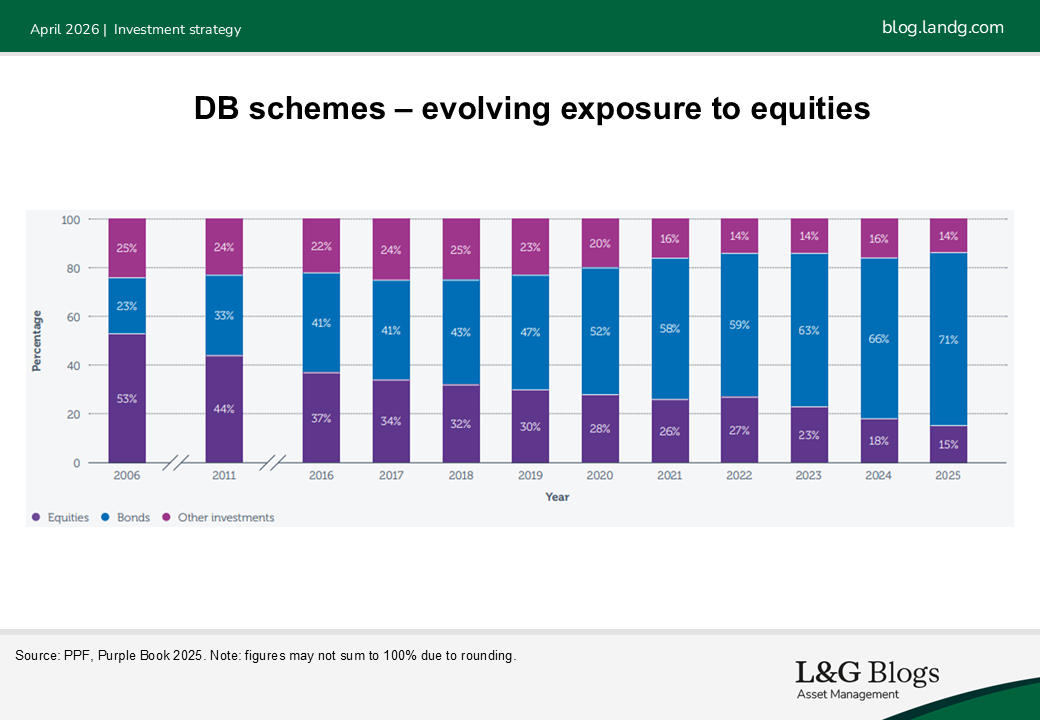
Indeed, against today’s backdrop of geopolitics, oil shocks, and AI-related disruption, DB trustees with equity exposure may ask: How best to maintain equity exposure while reducing the probability and severity of drawdowns that derail plans, and maintaining liquidity to manage collateral waterfalls?
A defensive equity strategy is one approach trustees may wish to consider in this context. By providing equity market exposure combined with a systematic equity option hedging overlay, it seeks to maintain equity market participation while aiming to reduce the magnitude of drawdowns and smooth volatility.
Although such a strategy cannot eliminate market risk or guarantee outcomes, its objective is to create a more controlled experience of equity exposure, especially during periods of heightened uncertainty. This outcome can be helpful for trustees that still want some growth, but want to avoid the potential disruption that large and sudden market falls can cause.
When is defensive synthetic equity appropriate?
The role of defensive synthetic equity is not to make big calls, but to seek to engineer a more robust participation in equity returns. It may thus be appropriate for today’s particular flavours of geopolitics, volatile commodity prices and AI disruption, but equally for future risks from different regions, new forms of technological change, shifts in policy, or entirely unforeseen shocks. What remains consistent is that equity participation can be shaped to target better stability, without removing all potential for long-term returns.
Practical use-cases for DB schemes
- Growth asset allocation for run-on: Within surplus allocation replace a portion of growth assets e.g. traditional equities, with defensive synthetic equity to improve downside characteristics while retaining broad equity participation. (For more details on run-on asset allocations including surplus see our blog: Investing for run-on)
- Staging post on the de‑risking path: As schemes progress toward an insurance endgame, the tolerance for deep market falls naturally reduces, making the shape of returns as important as the level. For maturing schemes who are considering reducing equity exposure but not yet ready to fully derisk or move to an insurance solution, then we believe an allocation to defensive equity can provide the potential for interim growth with lower drawdown risk, and may in fact enable schemes to be comfortable maintaining a larger exposure to equities than would otherwise be the case.
- Overlay simplification: Where schemes run separate option collars or dynamic hedges, migrating some exposure to a pooled defensive structure can simplify governance reporting and costs.
Smoothing DB scheme journeys
In a world where the only certainty is the persistence of uncertainty, the question is not what the next disruptive event will be. It is whether your asset exposure is designed to cope with disruptions whenever and however they appear. We believe that a defensive equity strategy offers one potential way to strengthen that foundation.

Recommended content for you
Learn more about our business
We are one of the world's largest asset managers, with capabilities across asset classes to meet our clients' objectives and a longstanding commitment to responsible investing.