Disclaimer: Views in this blog do not promote, and are not directly connected to any L&G product or service. Views are from a range of L&G investment professionals, may be specific to an author’s particular investment region or desk, and do not necessarily reflect the views of L&G. For investment professionals only.
Combining fundamental depth and systematic breadth in fixed income
Systematic active fixed income strategies draw on bottom-up credit research, quantitative insights and disciplined portfolio construction with the aim of enhancing returns from a core credit allocation.

Key takeaways:
- Fundamental research brings company-level depth: assessing how an issuer’s prospects are changing and whether its bonds adequately compensate investors for the risks.
- Quantitative analysis brings systematic breadth: comparing opportunities consistently across the investment universe and identifying potential sources of return.
- Portfolio construction puts both to work: combining these perspectives within defined controls around diversification, position sizing and benchmark-relative risk.
Seeking more from core credit
How can investors target enhanced returns from their core credit allocation while aiming to avoid excessive concentration risk? Systematic active can combine two complementary sources of investment insight: bottom-up research into individual companies and quantitative analysis across the investment universe. One aims to bring depth to understanding issuers; the other breadth and consistency to comparing opportunities.
Portfolio construction brings both together, seeking opportunities to outperform while keeping issuer concentrations and broader market exposures within defined limits.
The proposition is not fundamental versus quantitative investing. It is using their different strengths to build a more informed active credit portfolio.
Fundamental depth: understanding the company behind the bond
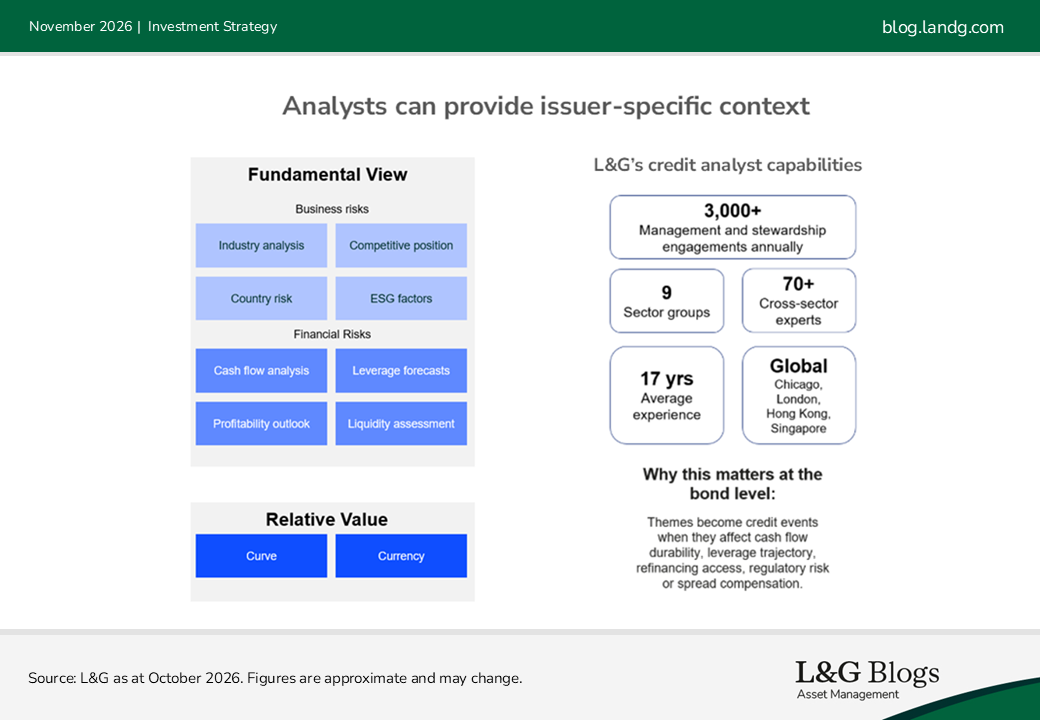
Two companies can operate in the same industry, carry similar credit ratings, and offer comparable bond yields, yet be heading in different directions. Bottom-up credit research examines how a business generates cash, the resilience of its balance sheet and how management’s decisions could affect creditors. Competitive dynamics, financing needs and capital-allocation priorities all contribute to that assessment.
Crucially, research connects company prospects with valuation. A strong business is not necessarily an attractive bond investment at any price. Analysts assess whether investors are being paid enough for the risks, identifying both potential opportunities and issuers where valuations leave little room for disappointment.
At L&G, for example, management meetings, site visits and conferences help analysts test assumptions about strategy, financing and financial resilience. These discussions complement independent financial and industry analysis rather than replace it.
The connection to implementation is explicit: analysts’ issuer assessments are translated into structured inputs that systematic processes can use. These assessments are sector-relative, comparing issuers with their industry peers rather than expressing a view on the direction of the entire credit market. This helps distinguish company-specific opportunities from broader sector positioning.
Systematic breadth: comparing the opportunities
Quantitative analysis is an investment engine, not simply a set of portfolio controls. It evaluates opportunities consistently across a broad universe, identifying relationships that can be difficult to assess issuer by issuer.
As discussed in our previous article, systematic analysis can assess potential opportunities associated with credit spreads, duration, yield-curve positioning, rolldown and subordination. These provide a different perspective from that of research focused on individual companies.
For example, a bond offering a higher spread than comparable securities may warrant attention. The investment question is whether that additional compensation represents an opportunity or reflects greater underlying risk. Systematic comparison helps frame that question consistently across many bonds.
Fundamental research approaches it from another direction: what is changing within the business, and does that change justify the market’s assessment? The value of combining the two lies in bringing complementary information to the same investment decision, rather than expecting either perspective to provide the complete answer.
Bringing the insights together
Consider two hypothetical issuers in the same sector. Fundamental research suggests that one is improving cash generation and prioritising debt reduction, while the other faces weakening financial flexibility.
Quantitative analysis asks a complementary question: how attractively are their bonds priced relative to the wider opportunity set? The improving company may already command a valuation that fully reflects its stronger outlook. The weaker company may offer additional yield, but not enough to compensate for its risks.
The investment decision therefore requires more than identifying the better business or the higher-yielding bond. It requires assessing the opportunity relative to the price, then deciding how much risk it deserves within the portfolio. Fundamental insight, quantitative comparison, and portfolio construction each contribute something different.
From individual opportunities to a portfolio
A potentially attractive investment idea is not, on its own, a portfolio strategy. Several ostensibly appealing positions could still create an unintended concentration in a sector, region, or common market exposure.
A systematic framework can combine analyst views and quantitative signals across many smaller active positions. Portfolio construction considers both the intended factor exposures and the contribution of individual issuers, subject to defined constraints around factor concentration and benchmark-relative risk.
This distinction matters. A portfolio intended to benefit from company selection should not inadvertently depend on a large sector or interest-rate position. The objective is not to eliminate active risk, but to understand it and allocate it deliberately.
A portfolio also need not hold only the highest-conviction issuers. Bonds assessed as broadly fair value can help balance exposures and maintain the intended risk profile. What matters is how the holdings work together, not whether every bond represents a strong standalone view. Diversification does not guarantee against a loss in a declining market.
Keeping the investment case and portfolio aligned
Company developments can change an analyst’s view. Market data can change a quantitative signal. Price movements can change a position’s contribution to portfolio risk. These are distinct reasons to reassess an investment.
Ongoing research, updated signals and systematic monitoring support that reassessment. Where exposures move beyond defined limits, monitoring may prompt rebalancing, subject to the strategy’s guidelines. A falling price does not automatically invalidate an investment case; continued conviction does not justify an unlimited risk allocation.
An integrated approach to core credit
For investors, the proposition is an active credit allocation that draws on both company-level judgement and systematic opportunity identification, without depending on concentrated positions.
Fundamental research can help to assess what may change within an issuer. Quantitative analysis compares opportunities consistently across the market. Portfolio construction aims to combine those insights within defined risk limits.
Systematic active approaches to fixed income can bring these capabilities together in a single strategy. The objective is straightforward: seek incremental returns through multiple investment opportunities, while aiming to keep the portfolio anchored to its intended risk profile.
The value of an investment and any income taken from it is not guaranteed and can go down as well as up, and the investor may get back less than the original amount invested. Risk management cannot fully eliminate the risk of investment loss. It should be noted that diversification is no guarantee against a loss in a declining market.



Recommended content for you
Learn more about our business
We are one of the world's largest asset managers, with capabilities across asset classes to meet our clients' objectives and a longstanding commitment to responsible investing.