Disclaimer: Views in this blog do not promote, and are not directly connected to any L&G product or service. Views are from a range of L&G investment professionals, may be specific to an author’s particular investment region or desk, and do not necessarily reflect the views of L&G. For investment professionals only.
As AI volatility rises, is it time to reconsider quality dividends?
We consider how quality dividend strategies may offer investors a broader source of equity returns, combining ongoing dividend growth, financial strength and improved diversification* at a time when markets remain heavily dependent on a handful of technology leaders.

Key takeaways
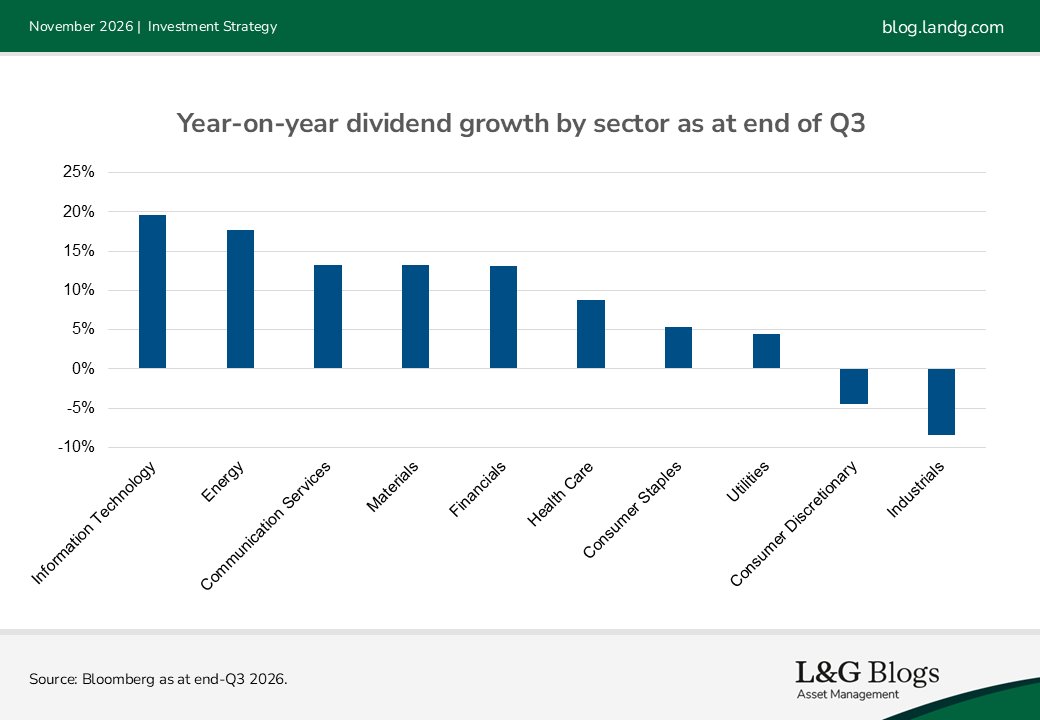
- Global dividends are growing: Underlying dividend growth reached 9.1% year on year in the second quarter of 2026.
- Looking beyond yield: Companies with strong financial fundamentals and a record of growing dividends may be better positioned to sustain shareholder payouts.
- A different approach to diversification: Combining quality and dividend growth with equal weighting can help reduce dependence on the largest companies and provide exposure to a broader range of equity opportunities.
Is there more to equity investing than the AI trade?
Last week’s tech sell-off saw the biggest decline in the Nasdaq index since the depths of the pandemic.[1] Following a more decisive US midterm result than had been widely expected, investors began to worry that Democrat gains could result in greater scrutiny of AI and datacentre expansion.
Much of the stock market dip has since been recovered, but the episode nonetheless pointed to the potential fragility of a narrative focused on one sector. This has market-wide significance given that AI-related stocks have been responsible for much of the S&P 500’s roughly 14% year-to-date return to the end of October.[2] The sector’s influence on corporate earnings, valuations and investor expectations has certainly been difficult to ignore.
Against this backdrop, we believe it may be worth looking beyond the companies driving today’s market headlines and considering those generating something quieter, but more tangible: cash returned to shareholders.
Dividends are quietly doing their job
Dividends rarely attract the same attention as share-price rallies. Yet corporate payouts remain an important component of equity returns. Global dividend payments remained robust through the middle of 2026. Across the second and third quarters, payments reached $1.45 trillion, up 7.9% from the same period in 2025. Growth was particularly strong in the second quarter, when dividend payments increased 9.1% year on year.[3]
For investors, dividends provide a potential source of cash flow without the need to sell shares, while reinvesting distributions can contribute to long-term compounding. Of course, dividends are not guaranteed, and a company’s decision to distribute cash does not automatically make it a good investment.
What matters, we believe, is whether those distributions are supported by the underlying strength of the business and can be sustained over time. That is where quality becomes particularly relevant.
The problem with chasing yield
Unfortunately, the relationship between dividends and the health of the business is not always straightforward. A company’s dividend yield can rise simply because its share price has fallen. If that decline reflects weaker earnings, rising debt or deteriorating business conditions, the apparently attractive yield may prove short-lived. Investors can then face the worst of both worlds: a dividend cut and further share-price weakness.
This makes the distinction between high yield and sustainable yield particularly important. Rather than focusing exclusively on current distributions, investors can also consider a company’s record of dividend growth, profitability and balance-sheet strength. The thinking goes like this: businesses that consistently generate profits, manage their finances prudently and have demonstrated an ability to grow dividends may be better positioned to sustain shareholder distributions through more challenging market conditions.
Instead of focusing simply on companies offering the highest yields today, this approach also considers dividend growth and quality characteristics, providing a broader lens through which to assess potential income opportunities. At a time when financing costs and economic conditions vary considerably between companies, that distinction could become increasingly valuable.
Another reason to look beyond market-cap weighting
Income is only one part of the investment case. The growing dominance of a handful of companies within conventional equity indices has renewed interest in alternative approaches to portfolio construction.
Market-cap-weighted indices naturally allocate more to companies as their market values increase. This has worked well during the technology-led rally, although it also means that a relatively small number of stocks can exert considerable influence over index performance.
Equal weighting takes a different approach. Giving eligible companies equal weights at each rebalancing reduces reliance on the largest index constituents and allows a broader range of businesses to contribute to returns. When combined with dividend and quality screens, this approach can provide exposure to established, cash-generating companies across different industries and market-capitalisation segments.
A broader approach to equity returns
The technology sector has the potential to reshape industries and create substantial opportunities for businesses and investors alike. But it is not the only investment story worth following.
Across global equity markets, companies continue to generate profits, strengthen their balance sheets and return cash to shareholders. Many receive considerably less attention than the businesses dominating today’s indices.
Quality dividend strategies still face equity market risk, and neither dividends nor capital growth are assured. Yet they offer a different way of participating in global equity markets, with less reliance on the continued outperformance of the largest companies.
Sources
[1] Bloomberg as at 6 November 2026.
[2] Bloomberg as 29 October 2026.
[3] Bloomberg as 29 October 2026.
*It should be noted that diversification is no guarantee against a loss in a declining market.

Recommended content for you
Learn more about our business
We are one of the world's largest asset managers, with capabilities across asset classes to meet our clients' objectives and a longstanding commitment to responsible investing.