
Disclaimer: Views in this blog do not promote, and are not directly connected to any L&G product or service. Views are from a range of L&G investment professionals, may be specific to an author’s particular investment region or desk, and do not necessarily reflect the views of L&G. For investment professionals only.
Securitised credit financing data centres: Opportunity or hidden risks?
As US securitised markets increasingly finance data centres, concerns about hidden risks are growing. How worried should investors be?

The race to build and operate data centres for current and anticipated AI demand is pulling in financing from multiple corners of the bond market. No single channel can satisfy the scale of capital required. Among these, US securitised credit has emerged as a key source, offering relatively attractive spreads for investors. Yet, some market participants are raising concerns about off-balance-sheet financing and structural risks. While we do see some risks beneath the surface that are important to monitor, we believe data centre securitisation can offer opportunity for investors.
Recent issuance trends
Securitised bonds backed by data centres have become one of the fastest-growing asset classes within the US securitised market. Issuance surpassed $25 billion in 2025, exceeding the combined total of the previous three years. To put this in perspective, the size of the US securitised market (ex-Government Sponsored Enterprises) is about $4.5 trillion, so small in comparison to the overall market.
Data centre asset-based securities (ABS) and commercial mortgage-backed securities (CMBS) have provided operators with relatively inexpensive, long-term funding for stabilised assets. Institutional investors’ appetite for higher-quality, longer-dated paper has driven issuers to lean into this demand.
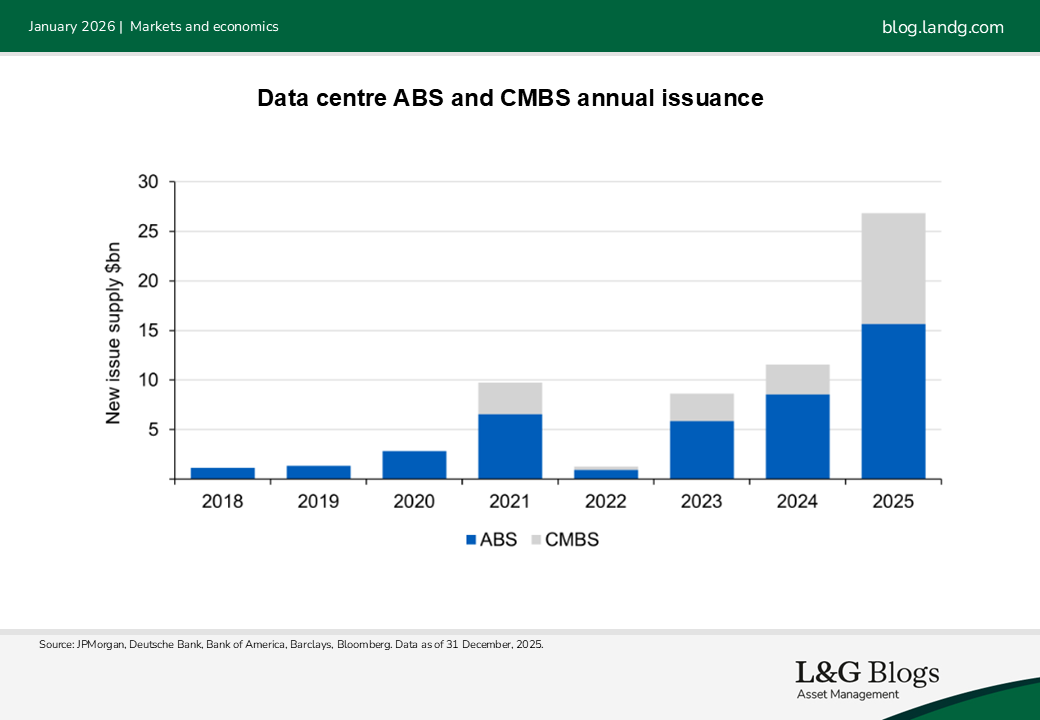
It’s important that we distinguish between the financing avenues being used by different parts of the credit market for data centre financing.
- Securitised credit: Typically used post-build-out for refinancing stabilised assets
- Public corporate bonds: Broader funding for large-scale operators
- Private credit: Flexible and fast access for construction-phase financing
Most securitised issuance focuses on refinancing income-generating assets rather than funding initial construction. ABS and CMBS structures suit assets with predictable cash flows—usually from long-term leases—making them ideal for refinancing once a data centre is fully built and leased. In contrast, construction-phase financing relies on private credit or project finance, which may be able to better absorb development risk.
In practice, these channels complement each other: Developers often use private credit for build-out, then refinance via securitisation to lock in lower-cost, long-term funding and free up capital for new projects.
Refinancing wall
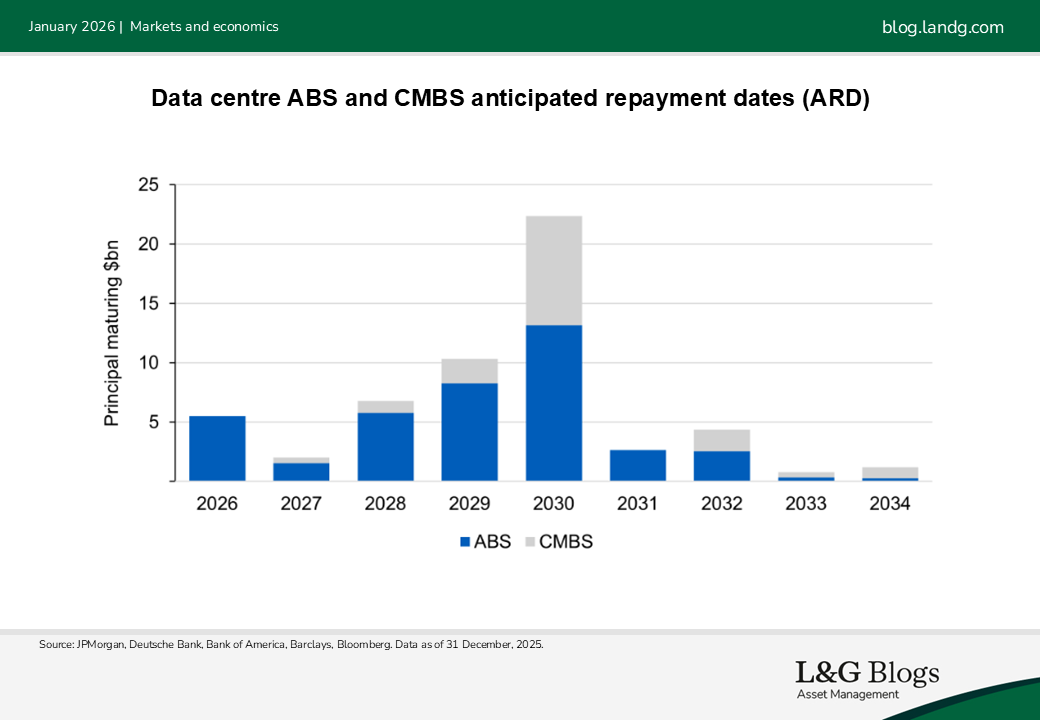
Near-term concerns about data centre securitisation are limited, but refinancing risk looms on the horizon, in our view. Given most transactions feature a 5-year anticipated repayment date (ARD), existing maturity walls start to become a more pressing matter in 2028-2030 (see chart below). If recent issuance trends persist, the ability to securitise new data centres will be critical as existing collateral ages and existing deals approach ARD.
Rewards and structural risks
We believe data centre ABS and CMBS offer compelling value relative to corporate debt and other securitised products. New issue spreads on recent data centre ABS transactions have priced 150-200 basis points (bps) over Treasuries and typically feature a 5-year weighted average life (WAL) and a single-A rating. These levels look attractive when compared to other securitised products such as whole business securitisations, where recent new issue spreads have priced closer to 115-130bps over Treasuries. We prefer deals backed by operators that have scale and history, as well as assets with desirable characteristics such as location and connectivity.
While the current backdrop of strong demand and hyperscaler expansion supports the sector, several structural risks warrant attention.
Overbuilding is a key concern. The race to deploy AI-ready facilities has led to aggressive capacity growth, but if AI model development shifts toward decentralised architectures or further relocates to regions with cheaper energy, utilisation rates could fall sharply. While we are already seeing development move to secondary and tertiary markets with cheaper or available power, we are not yet seeing a fall in utilisation rates in primary markets. For now, power constraints are a limiting factor in data centre development. Vacancies are also at record lows, with data centre demand continuing to outpace supply, especially amid cloud growth.
Technological obsolescence compounds the risk, especially for older data centres. Data centres are long-lived assets, often exceeding 15 years, yet AI hardware such as GPUs has a short lifecycle and requires frequent refreshes. This mismatch means operators may need significant ongoing capital expenditure and retrofitting of their existing data centres to remain competitive as customers’ hardware go through future refresh cycles. If these upgrades fail to keep pace with evolving compute requirements, today’s hyperscaler investments could lose relevance well before their full economic life is realised.
Finally, revenue uncertainty adds another layer of vulnerability. AI-driven workloads are expected to underpin growth, but if demand slows due to economic, regulatory or technological factors, lease renewals could be pressured, rental income reduced and vacancy risk elevated. While securitised deals benefit from current leases associated with traditional cloud and connectivity services, rollover periods present heightened exposure to these structural and market shifts. That said, revenue uncertainty could also inflect to the positive, as projecting AI-related demand is very challenging on a multi-year scale.
Closing thoughts
We believe data centre securitisation offers an attractive investment opportunity, supported by secular growth trends and appealing spreads. Cash flows also benefit from structural protections in the form of performance triggers and/or subordination and are less exposed to development risk and large-scale AI workloads. However, overbuilding, rapid technological change and uncertain revenue models introduce risks that investors must monitor closely as both the sector and asset class develop.
For those willing to navigate these challenges, we think data centre securitisation provides a compelling way to gain exposure to digital infrastructure—but sector expertise, disciplined underwriting, and stress-testing assumptions are essential to avoid hidden pitfalls in this highly dynamic space.
Assumptions, opinions, and estimates are provided for illustrative purposes only. There is no guarantee that any forecast will come to past.
Past performance is not a guide to the future.

Recommended content for you
Learn more about our business
We are one of the world's largest asset managers, with capabilities across asset classes to meet our clients' objectives and a longstanding commitment to responsible investing.