
Disclaimer: Views in this blog do not promote, and are not directly connected to any L&G product or service. Views are from a range of L&G investment professionals, may be specific to an author’s particular investment region or desk, and do not necessarily reflect the views of L&G. For investment professionals only.
Unlocking cyber security’s strategic potential
Structural drivers are fuelling the sector’s expansion and its growing influence in capital markets, particularly through elevated M&A premiums and potentially attractive valuations.

At a glance:
|
We believe the global cyber security market is set for robust growth and strategic importance, driven by its vital role in protecting digital infrastructure and enabling secure digital transformation.
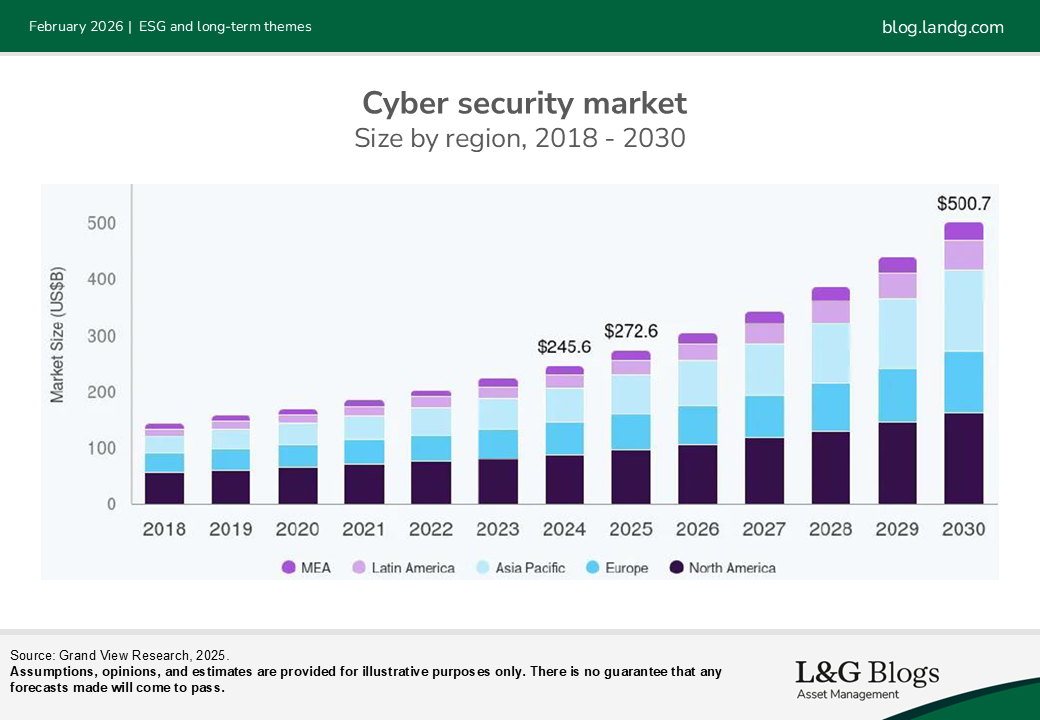
Statista forecasts a market size of $262 billion by 2030[1], while Grand View Research anticipates it could reach as high as $500 billion.[2] The overarching narrative remains clear: cyber security is becoming increasingly central to global digital resilience and is attracting substantial investment and innovation across industries.
A new era: from technical concern to strategic priority
The explosive growth of the cyber security market is driven by an urgent and widespread need for protection against increasingly complex digital threats. According to Statista, the global cost of cybercrime is projected to soar to $13.82 trillion annually by 2028, fuelled by sophisticated attacks such as ransomware, deepfake scams and AI-powered intrusions.
This rapidly evolving landscape is compelling governments, enterprises and critical infrastructure providers to significantly ramp up cybersecurity investments.
Beyond threats: innovation-driven growth
Artificial Intelligence (AI) is transforming threat detection and response. This technology enables real-time anomaly detection, automatic incident triage, and enhanced predictive capabilities, allowing organisations to anticipate and neutralise threats before they materialise. Gartner predicts that by 2030, pre-emptive cybersecurity solutions powered by AI will account for 50% of IT security spending (up from 5% in 2024), replacing many traditional detection-and-response models.[3]
A recent survey also found that 90% of organisations view AI and machine learning as critical to their cloud strategies, and 32% plan to invest heavily in AI-driven cybersecurity within the next 12 to 18 months.[4]
Cloud security has emerged as a standalone investment priority. With 60% of the world’s corporate data now stored in the cloud, organisations are increasingly focused on securing hybrid and cloud-native environments. According to SentinelOne*, there is growing demand for visibility and automation, with tools like Cloud Security Posture Management (CSPM) and Security Information and Event Management (SIEM) helping organisations monitor, detect and remediate threats in real time.[5]
Cyber security market momentum: strategic deals and valuation premiums
The sector is witnessing high levels of M&A activity, as strategic buyers and investors seek to consolidate capabilities across high-demand domains such as cloud security, identity management, and AI-driven threat detection.
In early 2025, major deals included Google’s* $32 billion acquisition of Wiz*, and Palo Alto Networks’* proposed $25 billion acquisition of CyberArk*, underscoring the strategic value placed on cybersecurity platforms.
Valuation data highlights investor interest in cybersecurity. According to Finro Consulting, M&A transactions in the sector are achieving some of the highest revenue multiples across the market, particularly in high-demand niches, such as cloud security, with companies in this space averaging 21.7x revenue multiples[6].
In its second-quarter 2025 Overview and 2025 Outlook report, Solganick observed that valuation multiples for publicly traded cybersecurity companies ranged from a median of 14.2x EV/2025E revenue for high-growth vendors (those growing more than 20%) to a median of 5.3x EV/2025E revenue for low-growth vendors (those growing less than 10%).[7]
Looking ahead, the convergence of AI, Zero Trust and quantum-safe infrastructure signals a new era of anticipatory security. With digital infrastructure becoming ever more critical, cybersecurity could remain a defining theme for investors seeking resilience and opportunity in a rapidly changing world.
Read the first part in the series to learn more about cyber security’s evolution.
*For illustrative purposes only. Reference to a particular security is on a historic basis and does not mean that the security is currently held or will be held within an L&G portfolio. The above information does not constitute a recommendation to buy or sell any security.
[1] https://www.statista.com/outlook/tmo/cybersecurity/worldwide
[2] https://www.grandviewresearch.com/industry-analysis/cyber-security-market
[5] CSPM helps identify and remediate misconfigurations and compliance risks across cloud infrastructure. SIEM systems aggregate and analyse data from across an organisation’s IT infrastructure.
[6] EV/Revenue
[7] https://solganick.com/wp-content/uploads/2025/07/Solganick-Cybersecurity-MA-Update-Q2-2025.pdf

Recommended content for you
Learn more about our business
We are one of the world's largest asset managers, with capabilities across asset classes to meet our clients' objectives and a longstanding commitment to responsible investing.